
Twin Falls County Blotter Scope
Twin Falls County has no official 72-hour, weekly, or rolling arrest blotter. The closest standing publication is the Sheriff's daily-report landing page. That page posts a current Arrest/Release PDF. It is the best first stop for a wider view of Twin Falls County recent arrests. It can capture booking and release activity from every law-enforcement agency in the county. Just know its limits. It is not a full historical arrest log. The roster PDF can also mix in sentenced people. It also lists people booked and released on pending charges, plus people released after an older booking.
Reading a multi-day window takes care with dates. The report's printed date is only its publication date. It is not the same as each booking or release date. An old booking paired with a fresh release is a release event. It is not a new arrest. The agency field tells you which organization handled the matter. It will not settle the final charge or outcome. For that, run the case number through the court docket. You can also ask the arresting agency for its underlying report.
Archive limit: the Sheriff's office publishes no guaranteed archive depth or roll-off schedule, so a PDF missing from the site may still exist as an agency arrest record even after the link comes down.
Read Multi-Day Arrest Entries
Check the dates first, then sort out what kind of event each entry is. That order keeps you from reading a custody update as a new arrest in Twin Falls County.
- Open the official report page and record the date printed on the current Arrest/Release file.
- Compare the booking date with the release date and time in each relevant entry.
- Read the hold and release reasons without treating abbreviations as a court judgment.
- Note the agency and case number for the next official request.
- If the desired date has disappeared, request that dated report from the Sheriff’s records unit.
- Check the court docket for later filings, changes, dismissal, plea, or judgment.
Each entry lists the usual fields. These include jacket number, name, date of birth, booking date, and release date and time. Hold reasons and release reason appear too. Common release reasons include bond, book-and-release, credit for time served, and own recognizance. Probation, warrant, IDOC, and out-of-county movement fill out the list. Each term explains a custody transaction. None of them guarantee a fresh arrest on the report's publication day.
| Reader’s goal | Best path |
|---|---|
| Review several recent days | Current dated Sheriff PDFs, followed by a date-specific records request. |
| Confirm present county custody | Headcount report and James R. Munn jail line. |
| Find selected incident coverage | Local news after official sources, with publication-date checks. |
| Learn the court result | Case number, court clerk, and Idaho iCourt docket. |
| Follow state custody | IDOC Resident/Client Search after state jurisdiction begins. |
Weekend Arrest Report Gaps
Twin Falls County puts out its arrest reports Monday through Friday, holidays excluded. Weekends get no catch-up. There is no fixed upload time. No guaranteed Monday compilation exists. A Saturday booking can sit outside the newest public file even though the arrest already happened. The reverse happens too. A Monday report may describe someone released well before the weekend. File silence proves nothing.
For same-day custody questions, switch to Arrests Last 24 Hours and run its urgent checks. For a multi-day search, keep a date list and request only the gaps. The James R. Munn Adult Detention Facility answers custody questions at (208) 734-9090; Sheriff records handles copies at (208) 736-4073, and VINELink sends release, transfer, or escape alerts without rebuilding a full police blotter.
Twin Falls Arrest News Sources
County documents come first. After that, two Twin Falls newsrooms add narrative context. KMVT Crime and Times-News/Magic Valley write about selected arrests, court appearances, sentencing, and police incidents. Neither posts a full booking roster. Stories can lag an event by days, center on one notable case, or cover another Magic Valley jurisdiction. Article photos may come from agency releases, reporters, or file imagery. Read each story's source and date separately.
The KMVT crime page displays a rolling list of selected regional stories.
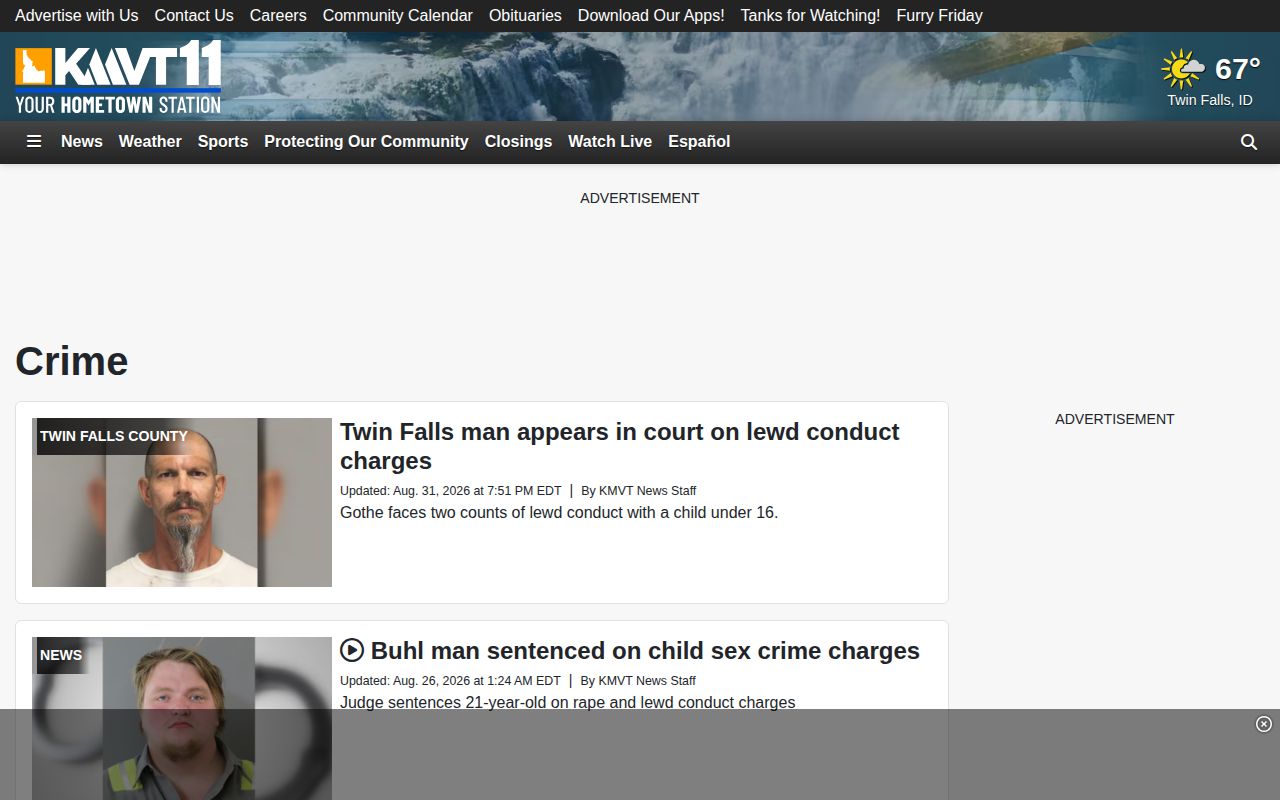
The story list is good for leads. Absence from it says nothing definite about county bookings. The Magic Valley news page offers another Twin Falls news route.

The paper's navigation shifts often, and its article archive is not an official arrest record.
No Twin Falls Checkpoint Log
Twin Falls drivers sometimes ask about DUI checkpoint logs. Neither the Sheriff's site nor the city police site publishes one. No enforcement-blitz feed or weekend roundup appears on either page. Individual news stories do cover a specific operation now and then. Those pieces can mention arrests made at a Twin Falls checkpoint. Piecing them into a countywide tally would misstate the record, though. Each account keeps its own agency name, incident date, and publication date. Treat each as one event. It is not a full arrest log. Twin Falls County News runs local incident stories too. Use it as a secondary lead. Then confirm names and outcomes with the Sheriff, the police agency, or the court.
Twin Falls Arrest Record Archives
Older Twin Falls arrest records still have a home. When a dated PDF rolls off, use the Sheriff's Civil Records request page. Name the report type. Give a date or narrow range. Add the person, the arresting agency, and any case or jacket number. The page lists a records phone and fax. No fixed booking-photo fee is published. Turnaround carries no guarantee either. A missing web link says nothing about whether the underlying record was destroyed.
Idaho Code §31-871 sorts county records into permanent, semipermanent, and temporary classes, each with statutory handling before destruction. That statute alone does not fix one retention period for every Twin Falls booking image. State records guidance covers criminal arrest histories and mugshot series, with felony and misdemeanor material treated differently, but the county itself must say which schedule governs a particular record.
For very old material, the Idaho State Archives may hold selected county, city, sheriff, or corrections records. Its searchable indexes include some Twin Falls County material along with historical penitentiary records. Those collections are not a current James R. Munn roster. Ask the Sheriff first about retention or transfer. Then submit an Archives research request with the name, approximate date, agency, facility, record type, and identifier.
Unofficial Twin Falls Arrest Pages
Third-party arrest pages trail the official channels. Read them with real caution. Mugshots.com has a Twin Falls County section, but the visible material runs mainly from 2012 through 2019. It is not a live booking feed. Busted Newspaper, RecentlyBooked, Arrests.org, and Mugshots.zone offer no local Twin Falls section, while AllInmates lists a directory page of unclear freshness. The historical Twin Falls County section shows why a local label alone proves nothing about recency.
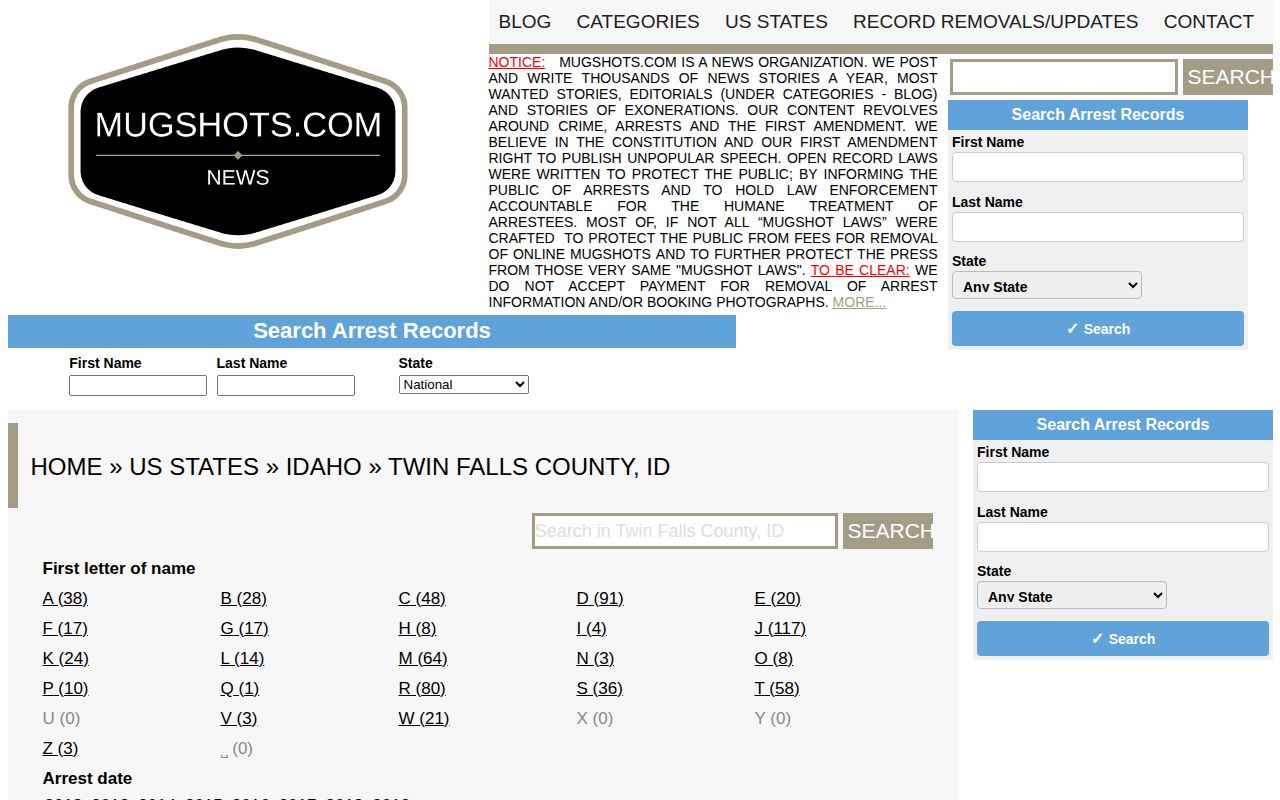
Check any entry against the county and the court before relying on it. These pages sit outside the official record.
Verify Twin Falls Arrest Outcomes
A blotter captures an early moment in a case. Charges can drop, change, or vanish after arraignment. An arraignment, after all, is only a first court appearance. A release reason is not a disposition. Match the full name and date before trusting a match. Identify the arresting agency too. Use the case number for court follow-up. The county publishes no booking-photo gallery, so request any needed image or report from its custodian. Juvenile rules, sealing orders, victim protections, and investigative exemptions can all block release.
Public Record Search
Sponsored Results